


Building a coordinate system on a surface - Part 2
(Or Math of GR part 10 for Calculus nerds)
So now we have rigid curved rods on the surface S. How do you build a coordinate grid on the surface to coordinatize a point on the surface with a value of u and v? You could just enter a value for u and v and find out where it is, by inserting it into the parametric equation. But how do you first see a point on the surface and then find out what coordinates it has?
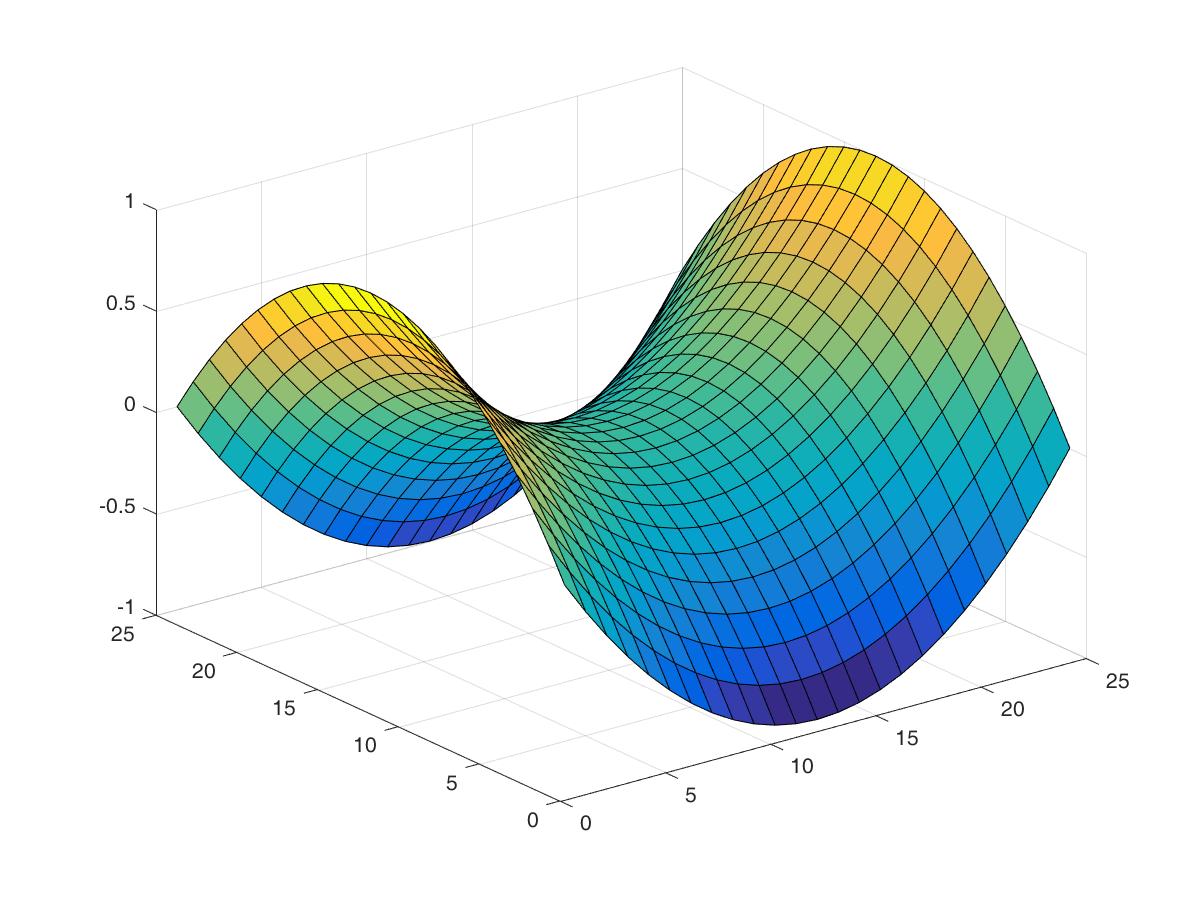
First thing, always be imagining a specific surface, like this one. Keep it real, so to speak. Note that we already have one U-curve, the U-axis, and we have one V-curve, the V-axis. What we want is to create a grid, just like on the picture, of parallel U and V curves. Let's create one on a small patch on the surface.
Let U = 0, and then graph the curves for V = negative 10, -9, -8, all the way to zero and then 1, 2, 3, all the way to 10. Then let V = 0, and then graph the curves for U = negative 10, -9, -8, all the way to zero and then 1, 2, 3, all the way to 10.
The Dirac Equation is Relativistically Invariant.
Proof attached.

Proving the Relativistic Energy-Momentum relation, the hard way and the easier way.