


Building a coordinate system on a surface - Part 3
(Or Math of GR part 12 for Calculus nerds)
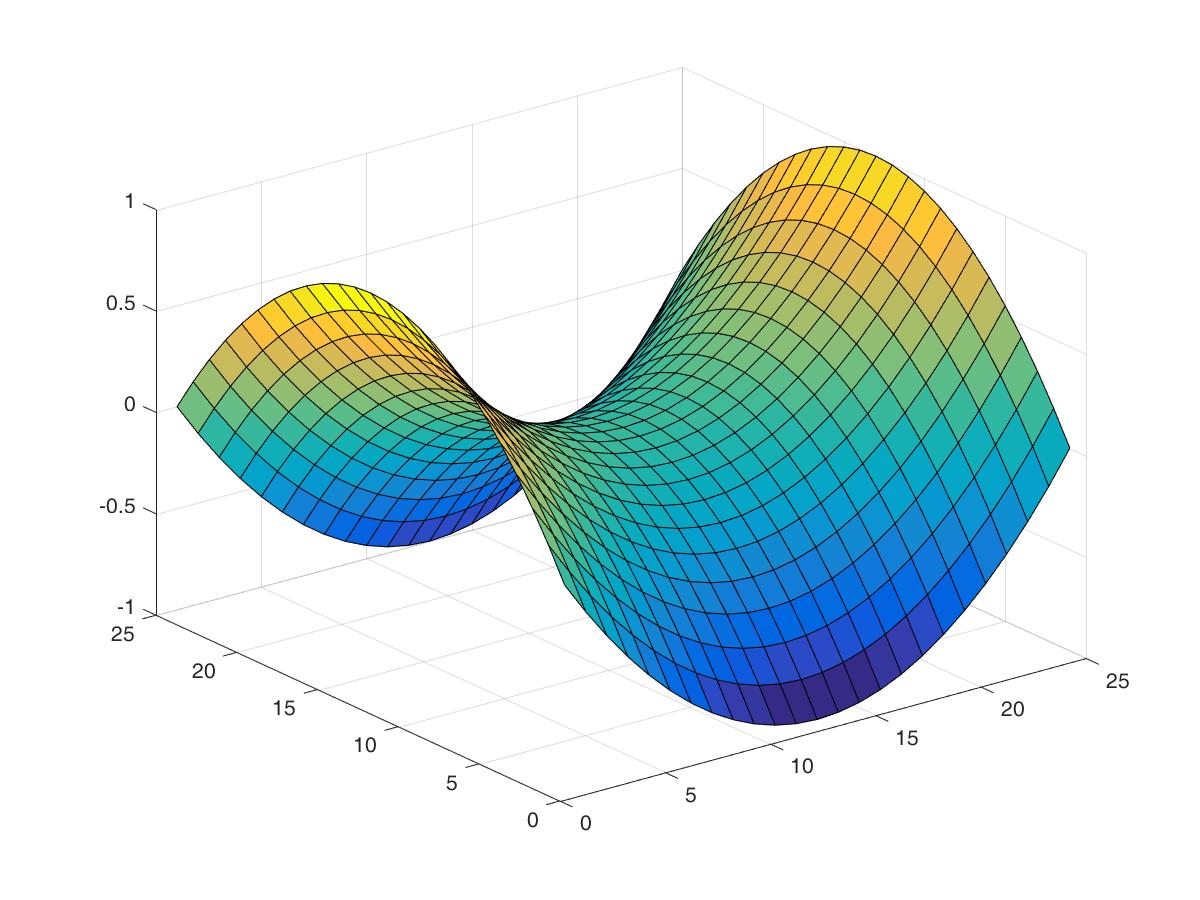
So now you have a grid just like the surface here. If an object is placed randomly among the grid, we can find its coordinates this way. Find out which U-curve and V-curve it touches. If the U-curve it touches is the one that was created by letting V = 0 and U = 7, and if the V-curve it touches is the one created by letting U = 0 and V = 3, then we say that its (u, v) coordinate is (7, 3). It is at point (7, 3).
Note that the point P is assigned the coordinates (7,3) RELATIVE to a specific parametric representation of the surface S. A parametric representation is an EQUATION that lets you develop the surface in a calculation, using two variables u and v.
There is more than just one equation that can develop such a surface. For instance, whatever the equation is, just add a number to it, like 87.58. This is a different equation, and it creates another gird pattern, or Coordinate System, albeit one that only is offset from the original one by 87.58 (inches or whatever system of units you are using) but STILL on the same surface.
The Dirac Equation is Relativistically Invariant.
Proof attached.

Proving the Relativistic Energy-Momentum relation, the hard way and the easier way.