


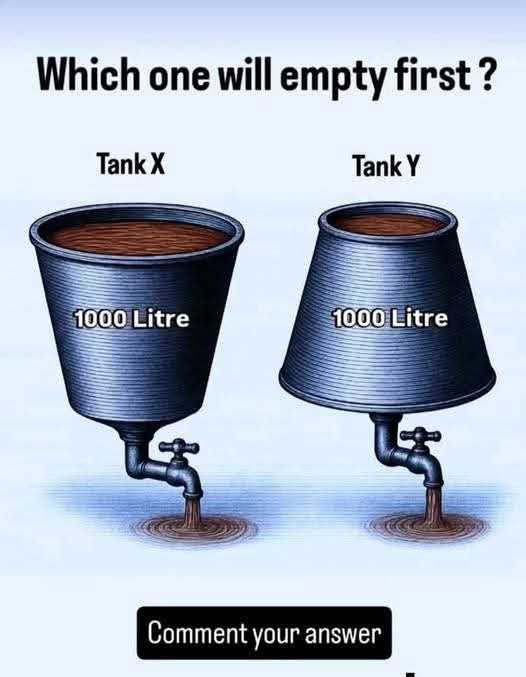
To determine which tank empties first, we need to model the draining process for each based on their shapes. Both tanks start with the same volume (1000 liters) and have identical outlets at the bottom, so we assume the same orifice area and fluid properties. The key physics principle is Torricelli's law: the efflux velocity at the outlet is
v=√2ghv = \sqrt{2gh}
, where (h) is the height of the fluid surface above the outlet, and (g) is gravity. The flow rate out is
Q=a√2ghQ = a \sqrt{2gh}
, where (a) is the effective outlet area (assumed constant and the same for both).The time to empty is found by considering how the volume changes:
dV=-A(h)dhdV = -A(h) dh
(where (A(h)) is the cross-sectional area at height (h)), leading to
dh/dt=-(a/A(h))√2ghdh/dt = - (a / A(h)) \sqrt{2gh}
. Integrating gives the total time
T=1/(a√2g) ∫_0^H▒(A(h))/√h dhT = \frac{1}{a \sqrt{2g}} \int_0^H \frac{A(h)}{\sqrt{h}} \, dh
, where (H) is the initial height. Since the constant
1/(a√2g)\frac{1}{a \sqrt{2g}}
is the same for both, we compare the integrals
∫_0^H▒(A(h))/√h dh\int_0^H \frac{A(h)}{\sqrt{h}} \, dh
.Assume both are conical with the same (H) and base radius (R) (yielding the same volume
V=1/3 πR^2 HV = \frac{1}{3} \pi R^2 H
).
For Tank X (wide at top, narrow at bottom: apex down):
A(h)=π(Rh/H)^2A(h) = \pi (R h / H)^2
. The integral is
π(R/H)^2 ∫_0^H▒h^(3/2) dh=π(R/H)^2⋅(2/5)H^(5/2)=πR^2 (2/5)√H\pi (R/H)^2 \int_0^H h^{3/2} \, dh = \pi (R/H)^2 \cdot (2/5) H^{5/2} = \pi R^2 (2/5) \sqrt{H}
.
For Tank Y (narrow at top, wide at bottom: apex up):
A(h)=πR^2 ((H-h)/H)^2=π(R^2/H^2)(H^2-2Hh+h^2)A(h) = \pi R^2 ((H - h)/H)^2 = \pi (R^2 / H^2) (H^2 - 2 H h + h^2)
. The integral is
π(R^2/H^2)[H^2⋅2H^(1/2)-2H⋅(2/3)H^(3/2)+(2/5)H^(5/2) ]=πR^2 (16/15)√H\pi (R^2 / H^2) \left[ H^2 \cdot 2 H^{1/2} - 2 H \cdot (2/3) H^{3/2} + (2/5) H^{5/2} \right] = \pi R^2 (16/15) \sqrt{H}
.
Comparing the factors:
2/5=0.42/5 = 0.4
for Tank X, and
16/15≈1.06716/15 \approx 1.067
for Tank Y. Since the integral is smaller for Tank X,
T_X<T_YT_X < T_Y
.Thus, Tank X empties first.
Tank X (the one wide at the top, narrow/apex at the bottom) empties first, as previously established.The emptying times are proportional to those integral factors we derived:
Tank X: factor = 2/5 = 0.4
Tank Y: factor = 16/15 ≈ 1.0667
Since time T ∝ factor (with all other constants like outlet size, gravity, total height, and volume being identical), we have:T_Y / T_X = (16/15) / (2/5) = (16/15) × (5/2) = 80/30 = 8/3 ≈ 2.6667Tank Y therefore takes 8/3 times as long to empty as Tank X.In other words:
Tank X empties 8/3 ≈ 2.67 times faster than Tank Y.
Equivalently, Tank X empties in 3/8 (≈ 37.5%) of the time that Tank Y requires.
This means Tank X is approximately 167% faster (it empties in roughly 37.5% of the time, so the "speed" of emptying is about 2.67× higher, or 167% more than Tank Y's rate).This ratio comes directly from comparing the ∫ A(h)/√h dh terms for the two opposing cone orientations under Torricelli's law. Many physics/engineering discussions and derivations (including exact calculations shared in posts and videos on the topic) arrive at the same 8/3 ratio for identical-volume, identical-height conical tanks.
The Dirac Equation is Relativistically Invariant.
Proof attached.

Proving the Relativistic Energy-Momentum relation, the hard way and the easier way.